The right distributor expands what is possible in veterinary medicine
By MWI Animal Health

TL;DR
- Advanced therapies require reliable distribution to reach patients
- Infrastructure, precision, and trust help clinics adopt innovation with confidence.
- Reliability means the right product, in the right condition, at the right time.
- Strong distributor partnerships reduce complexity and support better patient care.
- The right distributor expands what’s possible in veterinary medicine.
Companion animal practices today face a whirlwind of rising client expectations, cutting-edge therapies, and mounting pressure to deliver exceptional care, often under the strain of busy, resource-stretched clinics. Amid all this transformation, there’s one crucial decision that’s often overlooked: choosing the right distribution partner.
Distribution is sometimes viewed as a background function: moving products from point A to point B. But in reality, the distributor a veterinary practice relies on quietly shapes what care is possible, how reliably it can be delivered, and how confidently a clinic can adopt new therapies.
Behind every breakthrough therapy, smooth workflow, and consistent patient experience is a distribution partner making hundreds of coordinated decisions most clinics never see. As innovation accelerates across veterinary medicine, that behind-the-scenes role has never mattered more.
Veterinary medicine is evolving and so must distribution
The pace of innovation in companion animal care is not slowing. Regenerative medicine, biologics, and specialty therapies are moving steadily from the margins toward the mainstream, driven by scientific advances and rising demand among pet owners for more advanced treatment options.
Recent industry research from Gallant in partnership with AAHA highlights this shift, although regenerative medicine is just one breakthrough shaping how veterinary medicine must approach distribution more strategically.

Yet innovation does not reach the clinic on promise alone. The most sophisticated therapies only become clinically meaningful when they’re accessible. That requires infrastructure, precision, and trust, three factors profoundly influenced by distribution.
As care becomes more advanced, the question for practices is no longer just which products are available, but how reliably those products can be accessed, supported, and integrated into real-world care delivery.

Why distributor choice matters
As veterinary medicine continues to advance, distribution will increasingly influence which therapies scale, how quickly clinics can adopt innovation, and how manageable the total cost and complexity of care is.
Emerging treatments—from regenerative therapies to specialty biologics—often come with new handling requirements and tighter delivery constraints. Clinics that want to stay at the forefront of care need partners who think ahead, build infrastructure before it’s needed, and align operational strategy with where medicine is going and not where it has been.
That means asking deeper questions when evaluating a distributor. Not just what do they deliver, but how do they make innovation accessible? How do they support consistency as care becomes more complex? And how are they preparing for the next generation of therapies that will shape companion animal medicine?
“Innovation in distribution matters because it affects quality, cost, and the customer experience,” Bridger Tatum, Vice President of distribution at MWI Animal Health notes. “And those things only become more important as care becomes more complex.”
Access to innovation starts with trust and infrastructure
For emerging therapies, the final stage on the path to market is often the most sensitive. Years of research and development culminate in a moment where the product must be handled precisely, transported reliably, and delivered in a condition that inspires confidence at the point of care.
“There’s a tremendous amount of trust that comes with that final stage to market,” says Tatum. “They’ve taken years developing the product, with their human and financial capital tied up in it. When they pass it to us, there’s both trust and responsibility there.”
That responsibility goes far beyond storage space or shipping labels. It includes maintaining product integrity under exacting conditions, executing within tight delivery windows, and coordinating seamlessly with clinic schedules so therapies arrive precisely when patients need them.
The Gallant and AHHA research highlights just how critical this operational readiness is. Ninety-three percent of veterinarians say they are more likely to offer regenerative therapy if it is off-the-shelf, simple to administer, and easy to order. In other words, clinical interest alone is not enough. Distribution capability is often the difference between potential and adoption.
This is where the distributor’s role shifts from logistics provider to final clinical safeguard. Infrastructure investments, specialized cold-chain handling, and disciplined execution all become essential enablers of innovation, ensuring that advanced therapies reach practices in a way that supports confidence rather than complexity.
What reliability and innovation really mean inside the clinic
Reliability in distribution is often defined narrowly as “on-time delivery.” But for veterinary practices delivering advanced care, reliability means something far more precise: the right product, in the right condition, at exactly the right time.
The value of distribution goes beyond the products delivered to the clinic. It is defined by the partnership that supports veterinary teams every step of the way—through thoughtful conversations, collaborative planning, and practical problem solving. At MWI Animal Health, we prioritize understanding the unique needs of clinics, anticipating the future of care, and working alongside practices to ensure the right products, resources, and solutions are available exactly when they are needed.
“When a therapy has a limited window from shipment to administration, everything has to line up,” explains Julia Loew, Chief Commercial Officer at MWI Animal Health. “Once it ships, it has to be put into the animal within a certain period of time. That means the clinic can schedule the patient confidently, knowing the product will show up exactly when it’s needed.”

When distribution systems work as designed, this level of reliability fades into the background. Clinics experience fewer order issues, fewer callbacks, and greater confidence in scheduling patients—even for complex treatments. The operational burden doesn’t disappear, but it becomes manageable, predictable, and dependable.
Not all innovation announces itself with new products or cutting-edge therapies. Some of the most meaningful advances happen quietly inside distribution centers, within workflows, and across systems designed to improve accuracy and efficiency at scale.
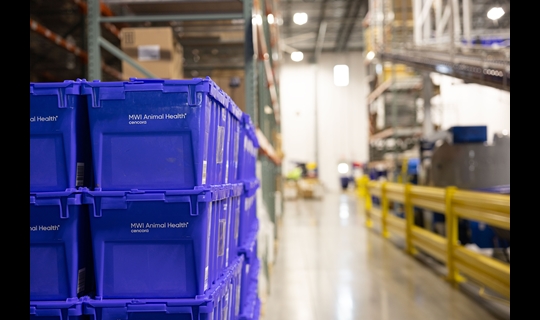
One example of system innovation is the MWI Animal Health sustainable tote delivery program. It combines white glove delivery service and order consolidation with reusable, stackable totes that reduce waste and ensure product integrity. Dedicated product delivery days means practices can better plan for receiving and allocating shipments. Less time unpacking boxes means more time caring for animals.
Automation, optimized picking workflows, and system-based quality controls help protect accuracy as volume grows. These investments may never be visible to a clinic, but their effects are felt in smoother operations, fewer surprises, and more consistent experiences. And making sure products get into the hands of veterinarians is the first step in treatment compliance—and ultimately healthier animals.
Choosing a distributor is choosing a future
Veterinary care thrives on collaboration among practitioners, manufacturers, and partners who bridge innovation with the realities of daily practice. At MWI Animal Health, this role surpasses the traditional scope of a distributor. It is about partnership. By understanding what clinics need, addressing operational challenges, and ensuring access to the right products and resources, MWI helps make advanced care more accessible and achievable. The right distributor doesn’t simply move product. It expands what’s possible, enabling access to new therapies, supporting confidence at the point of care, and providing a stabilizing force during rapid change.
When distribution works quietly and reliably, clinics can focus on what matters most: delivering advanced, compassionate care to the patients and pet owners who depend on them.
As veterinary medicine continues to evolve, the partners operating behind the scenes will play an increasingly decisive role in shaping what care looks like tomorrow—and how confidently clinics can step into that future.