Transforming feedyard efficiency with Accu-Trac®
By MWI Animal Health

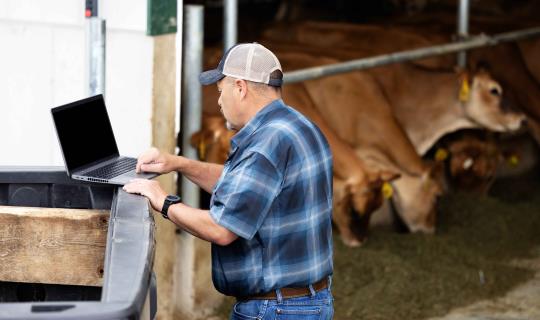
Managing a large feedyard requires balancing a wide range of responsibilities, and Evan Brown, General Manager of Phelps County Feeders in Nebraska, understands this challenge firsthand. With two feedyards representing 52,000 head of cattle under his supervision, Evan’s daily tasks include overseeing feed calls, ordering ingredients, monitoring animal health, and tracking cattle performance. “I operate mostly from my pickup in the feedyard, but I have Accu-Trac® open on my laptop all the time,” Evan explained.
Accu-Trac plays a central role in Evan’s ability to manage these tasks efficiently. He uses the system to track morbidity and mortality rates, review ingredient usage, pull headcounts, and assess cattle performance in real time. These capabilities are especially valuable as he moves between the two yards. Without Accu-Trac, Evan’s job would be significantly more difficult. “If Accu-Trac was taken away, it would be a longer day. I just lose all the efficiency,” he noted. The system’s ability to centralize data and streamline processes is critical for managing the complexities of large feedyards.
Features built for efficiency
Accu-Trac offers a variety of features, but Evan relies most heavily on the interactive yard sheet and the Read-N-Feed® system. These tools allow him to monitor feed consumption, assess cattle performance, and access detailed lot information such as headcounts and locations. The technology automatically records feed delivery and consumption data across all feed bunks, regardless of time of day or environmental conditions. These in-depth records allow Evan’s feedyard operators to trace consumption patterns to specific pens or cattle groups and make more accurate and efficient feeding decisions.
“The interactive yard sheet is something I use a lot,” Evan says. “It helps me dial in on issues that aren’t always the same. We might use different criteria to evaluate a certain scenario, like when to move cattle up on ration.”
The ability to customize how data is viewed and analyzed makes Accu-Trac a versatile tool for addressing the unique challenges of feedyard management. Phelps County Feeders and other users can adjust data layouts, reports, and dashboards to their needs. Teams quickly see the details that matter most. General managers, like Evan, can generate alerts, trend reports, or exceptions, improving their ability to react quickly to operational issues.
Evan praises this flexibility. “You can click on a lot, get information, and find endless details from that screen,” he explains. This immediate access to critical data not only saves time but also improves decision-making across the operation.
A transformational tool
Accu-Trac has transformed how Evan manages Phelps County Feeders by improving efficiency, accuracy, and overall operational oversight. The system’s real-time capabilities allow Evan to monitor and adjust operations without being tied to a desk. “It enables me to be more in tune with the whole operation when I’m here,” Evan shares. “It also gives me security when I’m away, because I can log in if I need to without having to come to the feedyard.”
One of the most significant benefits of Accu-Trac is the time it saves. By automating data collection and centralizing information, the system allows Evan to focus on higher-level management tasks. He uses the time gained to oversee all aspects of the operation more effectively, ensuring that every part of the feedyard runs smoothly.
The system also enhances animal health and performance by centralizing and streamlining data for better decision-making. For example, Evan uses Accu-Trac to monitor pull rates and determine when to initiate mass treatments for high-risk calves. Relying on Accu-Trac instead of finding this information by hand not only saves time for Evan and his team but also reduces potentially costly errors. Accu-Trac can show advanced analytics on treatment outcomes—stats that are difficult or even impossible to pull from manual record-keeping.
These insights help optimize herd health and reduce unnecessary interventions, ultimately improving productivity and profitability.
Collaborating for herd success
For Evan, the relationship with MWI Animal Health is just as valuable as the technology itself. “To me, it’s about the people,” he says. “The service guys and tech support have always been professional and reliable, no matter how intense I might be about getting something done.”
Evan has been using Micro Technologies products since 2003, and he has seen firsthand how the technology has evolved to become more efficient and user-friendly. “I remember when it used to take an hour or more to run the end of the day. Now it’s a five-minute process,” he recalls. This long-standing partnership has not only supported the growth of Phelps County Feeders but also provided Evan with the tools and expertise needed to manage a complex operation.
MWI continues to play a critical role in Evan’s success by offering hands-on training and ongoing support. Whether it’s troubleshooting technical issues or finding new ways to leverage the system’s capabilities, the team’s commitment to customer service ensures that feedyard managers like Evan can focus on what matters most: running a successful operation.